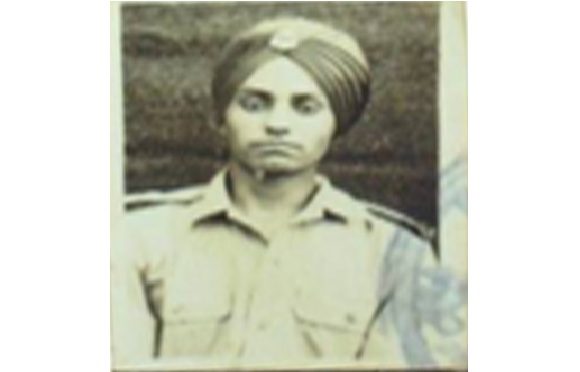
Sepoy Jaswinder Singh hailed from Toe Makhowal village in Dasua Tehsil of Hoshiarpur district of Punjab—a region renowned for its rich martial heritage and its long-standing contribution to the Indian Armed Forces. He was born to Shri Sardar Singh and Smt. Harban Kaur, who instilled in him the values of discipline, integrity, and a deep sense of patriotism. Raised in such an environment, he developed a strong sense of responsibility from an early age and nurtured a firm resolve to serve the nation. Driven by these ideals, he joined the Indian Army and was inducted into the 17th Battalion of the Punjab Regiment—one of the oldest and most distinguished infantry regiments, known for its illustrious history, battlefield gallantry, and unwavering commitment to duty. Becoming part of this prestigious regiment was both an honour and a responsibility, which he carried with pride and determination. Through his service, Sepoy Jaswinder Singh upheld the finest traditions of the Punjab Regiment and made a meaningful contribution to the enduring legacy of valour, sacrifice, and service that defines the Indian Army.
Operational Mission: 25th June 1979
In June 1979, Sepoy Jaswinder Singh’s unit, 17 Punjab Battalion of the Punjab Regiment, was tasked with an urgent internal security operation at Bokaro in present-day Jharkhand. The Army had been requisitioned in aid of civil authorities following a grave and unprecedented situation in which a group of Central Industrial Security Force (CISF) personnel had defied lawful orders, seized control of an armoury, and entrenched themselves within their barracks. The seriousness of the crisis was magnified by the substantial cache of weapons and ammunition in their possession, including hundreds of rifles and pistols and tens of thousands of rounds. Anticipating armed intervention, the defiant personnel had systematically converted the barracks complex into a fortified stronghold. The area was reinforced with wire obstacles and defensive ditches, while sandbagged bunkers on rooftops and first-floor windows provided commanding firing positions and clear fields of observation. On 23 June 1979, the Army moved in to restore order and secure the surrender of the armed personnel. By the night of 24–25 June, 17 Punjab Battalion had established a firm and effective cordon around the CISF barracks, isolating the complex and preventing any escape or reinforcement. A company of 17 Punjab Battalion under the command of Major Sukhdev Singh was tasked with spearheading the operation, with Sepoy Jaswinder Singh forming part of the assault element.
As the operation commenced, the assaulting troops advanced towards the armoury and adjoining office buildings but were met with intense and well-aimed rifle fire from CISF personnel positioned in elevated bunkers. The defenders’ advantageous positions made the approach extremely hazardous and slowed the momentum of the assault. Simultaneously, another company was assigned to cordon off a barrack located behind the Sabha Hall and compel the surrender of the personnel inside through a direct assault. Sepoy Jaswinder Singh, who was among the leading elements of the assaulting troops, entered the building with his section and engaged the entrenched personnel in fierce close-quarter combat. Displaying exceptional courage, leadership, and presence of mind, he pressed forward under heavy and accurate fire, determined to neutralize resistance and secure the objective. While flushing out the occupants, he was struck by a bullet fired from a bunker, sustaining grievous injuries. Despite being immediately evacuated to a military hospital, he succumbed to his wounds on 28 June 1979. Sepoy Jaswinder Singh’s conduct throughout the operation reflected exemplary bravery, unwavering determination, and an unflinching commitment to duty. His courage in the face of grave danger and his steadfast devotion to the mission epitomized the highest traditions of the Indian Army. In the course of this operation, besides Sepoy Jaswinder Singh, Major Sukhdev Singh and Sepoy Manjit Singh also made the supreme sacrifice, underscoring the high cost of restoring order in such a volatile and dangerous situation. In recognition of his conspicuous gallantry and supreme sacrifice, Sepoy Jaswinder Singh was posthumously awarded the Shaurya Chakra.

No Comments